
Executive Summary
Section 2 explains the two main types of climate risks facing financial institutions: physical risks and transition risks. The section highlights the need to balance physical and transition risks across different time horizons. Managing climate risks requires a shared, structured approach across all functions within FIs.
Defining climate risks and their impacts
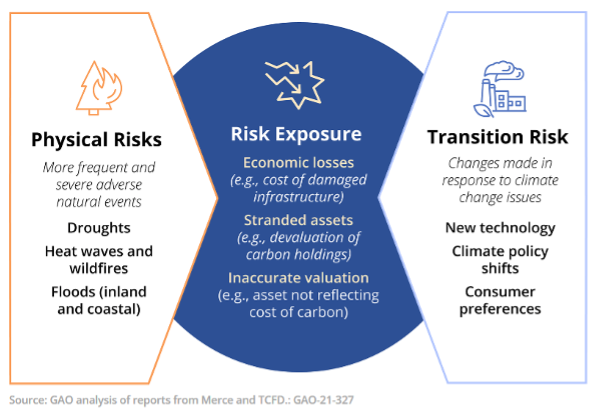
Climate risks to businesses fall into two main categories:
- Physical risks: the direct effects of extreme weather events or long-term changes in weather patterns, such as floods, droughts or rising temperatures.
- Transition risks: arising from the move towards a low-carbon economy, including changes in policy, technology, markets and reputation.
Physical risks
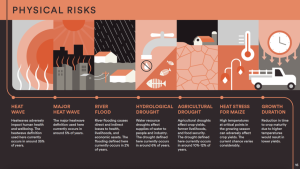
Physical risks fall into two categories:
- Acute risks: These are event-driven risks linked to more frequent or severe extreme weather events such as cyclones, heatwaves or floods.
- Chronic risks: These involve longer-term changes in climate patterns, such as prolonged droughts, land losses from rising sea levels or shifts in where crops and disease-carrying insects can survive.
Physical risks can damage assets and infrastructure, disrupt supply chains, and threaten people’s health and safety. They may also lead to wider financial and economic shocks.
Transition risks
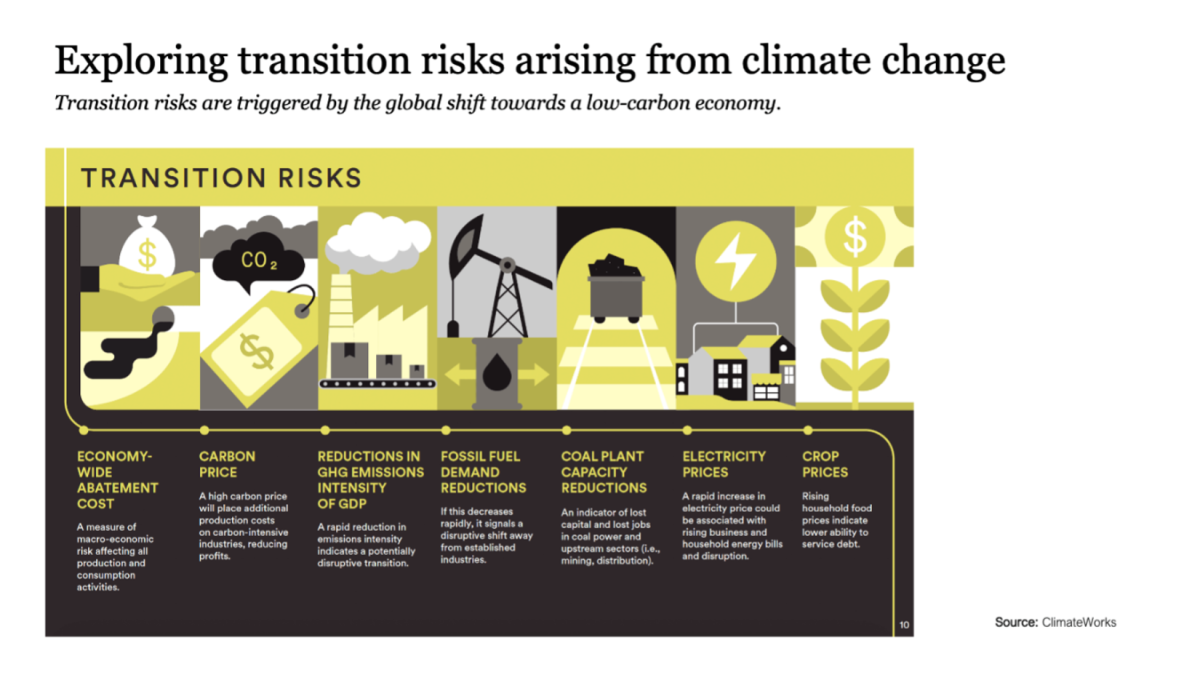
Transition risks stem from the global move towards a low-carbon economy, and can be grouped into four main areas:
- Policy and Legal risksRisks from new laws, regulations or policies aimed at reducing emissions or adapting to climate change.
- Technology risksRisks linked with new technologies or business models that support the transition to a low-carbon economy and may disrupt existing industries.
- Market risksRisks arising from changes in supply and demand as businesses and consumers respond to climate-related risks and opportunities.
- Reputation risksRisks related to how an organisation is perceived in terms of its positive or negative contribution to the low-carbon transition.
Transition risks can affect an organisation’s financial performance directly, for example, through climate-related litigation, or indirectly through greater uncertainty in operating conditions and markets.
Navigating climate risk across time horizons
As climate change accelerates, the financial and environmental impacts of extreme weather are increasing. Acting early is critical, as delays will lead to greater costs and damage over time. There is a fundamental balance and trade-off between physical climate risk and transition climate risk: rapid, aggressive action to mitigate climate change increases near-term transition risks (e.g., stranded assets, policy changes, new technology costs), while delayed or insufficient action reduces transition risks in the short term but leads to higher long-term physical risks.
If climate action is delayed, long-term physical risks and irreversible losses become more apparent. However, taking decisive action to reduce emissions also brings transition risks, which can cause short-term disruption for economies and sectors. The challenge for both countries and companies is to manage these risks across different time horizons, accepting some short-term transition risks to prevent far greater long-term physical harm.
Managing climate risks is a shared responsibility within FIs
Unlike traditional financial risks, climate risks are complex, evolving, and not easily measured using existing data or models. They cut across science, policy, and markets, and span various specialisms and responsibilities/roles.
Addressing this complexity requires broader commitments. It calls for a structured, capability-driven approach that embeds climate risk into core business functions. Managing climate risk is not the responsibility of one department within an FI, but a shared mandate that touches every function.
For organisations ready to move from awareness to action, the path forward involves a series of deliberate steps: clarifying scope, building internal capability, leveraging data, and integrating climate insights into risk management and decision-making frameworks.
This toolkit aims to bring clarity to the roles, responsibilities and decision points that underpin effective climate risk management.